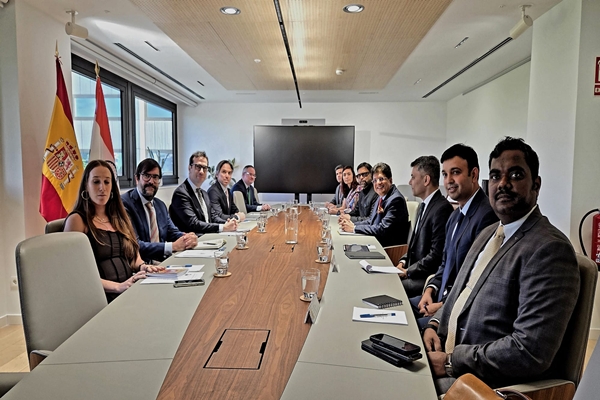
Commerce and Industry Minister Piyush Goyal began official engagements in Spain with discussions aimed at deepening trade, investment and technology ties between the two countries.
Akashvani said that Goyal met Carlos Cuerpo Caballero, Spain's First Vice President and Minister for Economy, Trade and Business. The talks covered economic partnership, advanced manufacturing, digital technologies, infrastructure, renewable energy and green hydrogen.
Diplomatic economy
The Spain stop is part of a wider five-day visit covering Spain, Belgium and Finland. That route is important because it places bilateral talks inside the larger India-Europe economic conversation, including the India-EU free trade agreement negotiations.
Spain is relevant for India not only as a market, but as a partner in renewable energy, infrastructure, defence manufacturing, technology and mobility. Green hydrogen is especially significant because it connects industrial policy, climate commitments, energy security and future export competitiveness.
Trade lens
The strongest outcome from such visits is usually not a single announcement, but a pipeline of agreements, investor meetings and regulatory alignment. Businesses will watch whether the talks produce sector-specific commitments in clean energy, manufacturing, digital services and logistics.
The visit also comes at a time when global supply chains are being reworked around resilience and trusted partnerships. That gives India-Spain engagement a wider strategic value beyond the immediate trade numbers.
Renewable energy cooperation is likely to be watched closely because Spain has experience in solar, wind and grid integration, while India offers scale and a large domestic market. Green hydrogen adds another layer because it needs technology, finance and long-term offtake agreements.
The India-EU trade track is the larger backdrop. If bilateral conversations with Spain, Belgium and Finland improve trust around standards and market access, they can support the political momentum needed for broader negotiations.