India's maritime strength depends on a balanced fleet protecting national interests across the full spectrum of naval operations. The Nilgiri, Sandhayak and Arnala classes represent three vital pillars of this capability. Recently commissioned INS Dunagiri, INS Sanshodhak and INS Agray demonstrate the steady expansion of these indigenous warship classes. INS Mahendragiri further strengthens this capability. Built with high indigenous content, these platforms embody Aatmanirbhar Bharat and strengthen India's defence manufacturing ecosystem. Together, they enhance maritime security, support the Blue Economy and reinforce India's position as a leading maritime power.
The ability to deter and fight on the ocean surface sits at the front of this structure. The latest in this segment are Nilgiri-class stealth frigates which are built under Project 17A for high-intensity operations. Their reduced radar, thermal and acoustic signatures improve survivability in combat.
Maritime power also depends on a deep understanding of the seas. The Sandhayak-class Survey Vessel (Large) ships strengthen India's hydrographic capability. They map the seabed, gather ocean data and produce accurate nautical charts for safe navigation. This work supports naval operations, maritime trade and the Blue Economy, and it reinforces India's standing as a trusted hydrographic partner across the Indian Ocean Region.
Closer to the coastline, anti-submarine warfare forms the next layer of defence. The Arnala-class Anti-Submarine Warfare Shallow Water Crafts are designed to detect and neutralise submarines in littoral waters. Alongside their core roles, all three classes can take on humanitarian assistance, disaster relief and search and rescue missions.
Together they mark the success of India's indigenous shipbuilding programmes. Their move into serial production strengthens maritime security, advances Aatmanirbhar Bharat and shows India's growing ability to design and build its own warships.
On 21 June 2026, three indigenously designed and built platforms were commissioned together at Kolkata: INS Dunagiri, a Nilgiri-class stealth frigate; INS Sanshodhak, a Sandhayak-class survey vessel (large); and INS Agray, an Arnala-class anti-submarine warfare shallow water craft. All three ships were designed by Navy's own Warship Design Bureau and manufactured by the Garden Reach Shipbuilders and Engineers Limited (GRSE), Kolkata, a defence public sector undertaking.
On 11 July 2026, the sixth indigenously designed and built Nilgiri-class stealth frigate INS Mahendragiri was commissioned at Visakhapatnam.
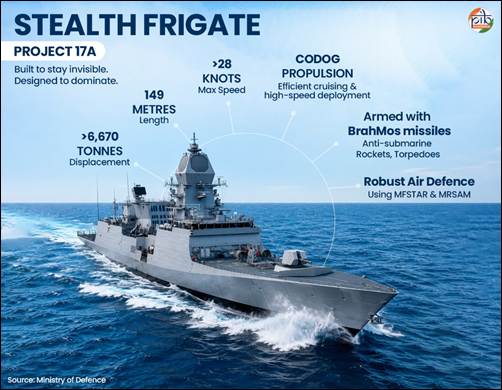
Stealth frigates form the backbone of the Indian Navy's surface combat capability. They protect aircraft carriers, secure vital sea lanes and project power across distant waters. Designed for modern naval warfare, they integrate advanced weapons, sensors, and aviation facilities while optimizing radar, infrared (thermal), and acoustic signatures for enhanced stealth. This makes them difficult to detect while enabling both offensive and defensive operations.
A represents the latest generation of indigenous stealth frigates. The Nilgiri-class comprises INS Nilgiri, INS Himgiri, INS Taragiri, INS Udaygiri, INS Dunagiri, INS Mahendragiri and the under construction Vindhyagiri. Mazagon Dock Shipbuilders Limited, Mumbai, built four ships, while Garden Reach Shipbuilders and Engineers Limited, Kolkata, is building three. The latest additions to the class, INS Dunagiri, was commissioned recently as its fifth ship and INS Mahendragiri, the vessel of the class, was commissioned on 11 July 2026 at Visakhapatnam. These warships strengthen India's maritime security and reinforce its presence across the Indian Ocean.
Project 17A is the Indian Navy's advanced stealth frigate programme to build seven next-generation guided-missile warships. These frigates are designed for multi-mission operations, including anti-air, anti-surface, and anti-submarine warfare. Project 17A reflects India's growing strength in self-reliant warship design and construction.
Key specifications of Project 17A Nilgiri-class Stealth Frigates.
Size: Around 149 metres long, displacing about 6,670 tonnes. Displacement is the weight of water a ship pushes aside.
Propulsion: A Combined Diesel or Gas (CODOG) system, that is Combined Diesel or Gas, pairing diesel engines with gas turbines for range and speed.
Speed: Maximum speed of 28 knots. A knot is about 1.85 kilometres per hour.