With this exceptional performance, India secured the World No. 1 rank, jointly with China, Kazakhstan, Russia, South Korea and Taiwan, among 381 students from 87 countries, reaffirming the country's growing stature in science education and excellence at the international level. The Indian medal winners are.
This remarkable accomplishment extends India's proud legacy at the International Physics Olympiad, with every Indian participant over the last decade securing a podium finish.
The achievement reflects the strength of India's Olympiad programme, spearheaded by the Homi Bhabha Centre for Science Education (HBCSE), a National Centre of the Tata Institute of Fundamental Research (TIFR), an aided institution under the Department of Atomic Energy (DAE). As the nodal centre for the Olympiad programme in India, HBCSE serves as the country's link to the international Olympiad community and is dedicated to identifying, nurturing and mentoring exceptional talent in science and mathematics among pre-university students through a rigorous multi-stage selection process, orientation camps and intensive training programmes.
Dr. Ajit Kumar Mohanty, Secretary, DAE & Chairman, Atomic Energy Commission, congratulated the medal winners and said, "This phenomenal achievement by our young physicists is a matter of immense pride for the nation. Securing five Gold Medals and jointly attaining the World No. 1 rank at the International Physics Olympiad is a testament to the talent, dedication and scientific temperament of our students, as well as the unwavering commitment of the HBCSE-TIFR Olympiad programme. I congratulate the students, their parents, teachers, and mentors for this remarkable accomplishment. Their success inspires countless young minds to pursue excellence in science and reinforces India's growing leadership in scientific education and innovation.".
The Department of Atomic Energy also congratulates the team leaders Prof. Anwesh Mazumdar (HBCSE-TIFR) and Dr. Leena Joshi (St. Xavier's College, Mumbai), the scientific observers Prof. Ananda Dasgupta (IISER, Kolkata) and Ms. Nisha Kelkar (Gogate-Joglekar College Ratnagiri), and the Physics Olympiad Team and mentor pool at HBCSE for their unwavering dedication in preparing India's brightest young minds for the global stage.
Prof. Arnab Bhattacharya, Centre Director, HBCSE, pointed out that the now routine achievements of Team India in the Science and Mathematical Olympiads were the result of patient growth and mentoring over decades. While there have always been exceptionally talented students and passionate and patient mentors, it is thanks to the Department of Atomic Energy offering their unstinted support over many decades that Team India has been able to reach where is has today.
The outstanding performance at IPhO 2026 once again demonstrates DAE's continued commitment to fostering scientific excellence among school students and building a strong foundation for the nation's future scientific and technological leadership.
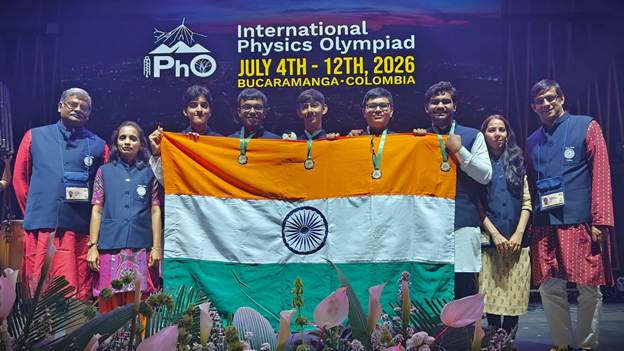
The Indian Contingent comprising the five Gold Medal winners, team leaders and scientific observers at the 56th International Physics Olympiad (IPhO) 2026, Bucaramanga, Colombia.
India's young physicists have brought immense pride to the nation by delivering an extraordinary performance at the 56th International Physics Olympiad (IPhO) 2026, held in Bucaramanga, Colombia, with all five members of the Indian team winning Gold Medals.