On most nights, a handful of people are driven to a quiet and unfenced stretch of India-Bangladesh boundary and walked across in the dark when the Border Guard Bangladesh (BGB) is not standing watch.
This sounds like a leak from an intelligence file, but this is more or less what Himanta Biswa Sarma, Chief Minister of Assam, described in an interview about illegal immigrants.
Handing suspected undocumented Bangladeshis back through the Ministry of External Affairs is slow and uncertain, he explained, because Dhaka does not readily accept them and there is no functioning extradition arrangement for such cases.
So, the state waits for nightfall and, in his own phrase, takes them to a convenient place and practically pushes them across.
He describes this mechanics as “push-back” while Bangladesh calls it “push-in”.
In the days that followed, Dhaka formally raised the issue and summoned India’s Acting High Commissioner to lodge a protest.
As of May 2026, Sarma is no longer the only BJP chief minister with his hand on the India-Bangladesh border.
He has a new and equally combative counterpart in West Bengal.
The BJP’s landslide victory in Bengal, ending 15 years of Trinamool Congress rule, was celebrated in Guwahati as much as in Kolkata.
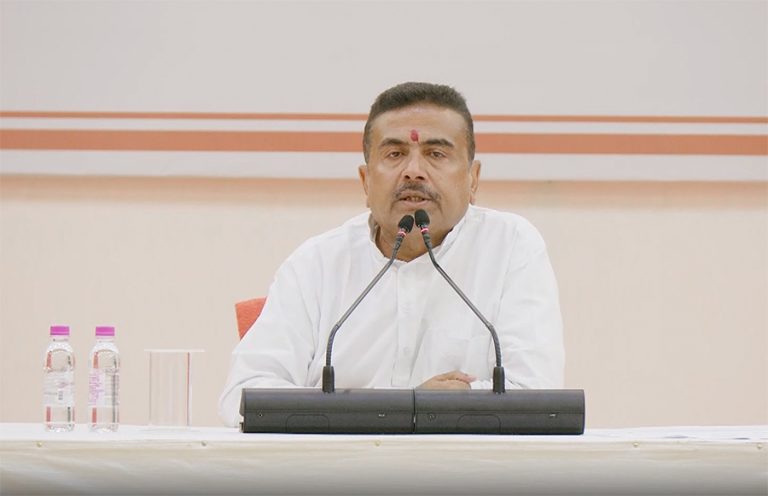
Suvendu Adhikari, who defected from the Trinamool in 2020 and spent five years as Leader of the Opposition, was sworn in as the State’s first-ever BJP Chief Minister.
Sarma, re-elected in Assam for a second consecutive term, called the West Bengal result “India’s victory”.
For 15 years, the levers of the border were controlled in West Bengal by Mamata Banerjee, whose calculus was shaped by a substantial Muslim electorate and a deep base in the border districts.
Now for the first time, along the entire India-Bangladesh border that stretches for 4,096 km along five States will be operated by a government run by the BJP and its allies that rides heavily on anti-immigration rhetoric.