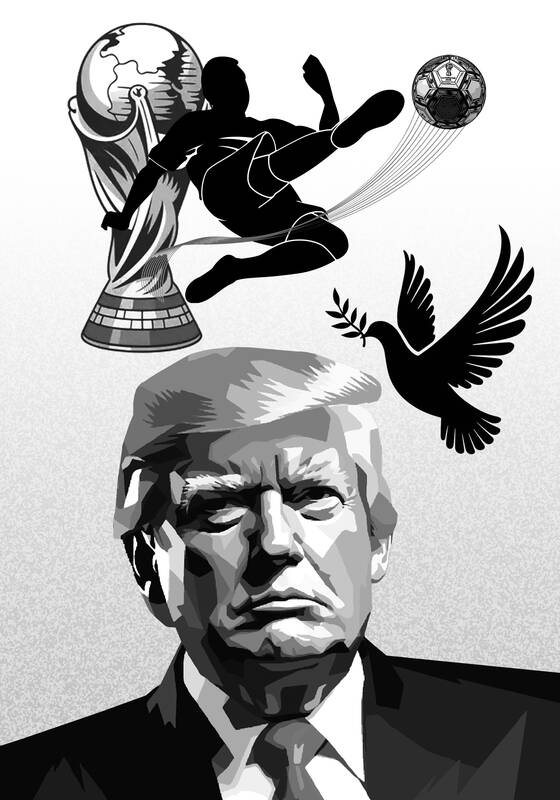
Three world leaders shared the stage, representing the tournament’s co-hosts in this first-ever trinational cup: US President Donald Trump, Mexican President Claudia Sheinbaum and Canadian Prime Minister Mark Carney.
There was no love lost between Trump and the other two after he had hinted at military intervention in Mexico and the annexation of Canada, in keeping with his claim to dominate the whole Western Hemisphere, from Venezuela and Cuba to Greenland.
When FIFA, the international federation of soccer associations, awarded the 2026 cup to the three co-bidders during Trump’s first term, their cooperation was supposed to highlight the integration of the North American continent.
An early and optimistic slogan was “United As One.”.
That does not sound right anymore in Trump’s neo-imperialist second term, when intermittent trade wars have replaced the old dreams of a free-trade area.
(The official FIFA slogan is now “WE ARE 26.”) Continental politics have entered an ice age, and Carney has become something of a leader in the global resistance against Trumpism.
And yet soccer presents diplomatic opportunities that no other forum — neither the UN, NATO, the World Bank, the G20 nor anything else of that ilk — can provide.
Sheinbaum and Carney performed gamely next to Trump, pulling country names for the group assignments as though they were on a game show.
The trio then retreated to a private room for a trilateral chat.
In that way, soccer is ideal for providing what diplomats call “structured informality.” Table tennis, cricket and other sports have also bridged gaps of animosity, but soccer is unique because so much of humanity loves it.
In the stands and on the pitch, fans and players are “divided by jerseys, united by their passion through sports,” said Travis Murphy, a veteran of the US State Department who now runs a company that promotes sports diplomacy.
Up in the VIP suites, he added, soccer is “the most reliable convening instrument that we have on the international stage.”.