2015, the International Day of Yoga (IDY) has evolved from a United Nations-designated annual event into one of the world's largest participatory wellness movements. It brings together millions of people across countries, cultures and communities through the shared practice of Yoga. The 2026 edition, themed 'Yoga for Healthy Ageing'(स्वस्थ आयु के लिए योग), carries this journey forward through nationwide participation, innovative initiatives and year-round engagement, while promoting preventive healthcare and active living.
Recognising its universal appeal and benefits, the United Nations proclaimed 21 June as the International Day of Yoga in 2014. The proposal, introduced by Prime Minister Shri Narendra Modi at the 69th session of the UN, was supported by 175 member states. The first observance was held on 21st June 2015.Yoga was inscribed on UNESCO's Representative List of the Intangible Cultural Heritage of Humanity in 2016.
This landmark recognition acknowledged India's contribution to global wellness. It also carried yoga's journey to a new stage, transforming it into a worldwide celebration across continents. Since then, the observance of International Day of Yoga has strengthened yoga's role as a bridge between nations, promoting health, harmony, and sustainable lifestyles.
Yoga is among the world's oldest knowledge traditions, with roots tracing back to the Indus-Saraswati Civilisation (c. 2700 BCE). The word 'yoga' derives from Sanskrit, meaning to join or to unite - symbolising the union of body and consciousness[1].
References to Yogic practices are found across the Vedas, Upanishads, Buddhist and Jain traditions, as well as the Mahabharata and Ramayana.
The Yogic tradition was systematised by Maharishi Patanjali through the Yoga Sutras, laying the foundation for its philosophical and practical framework. Over centuries, sages and Yoga masters have preserved and enriched this knowledge, helping it spread across the world.
While International Day of Yoga is celebrated across India through thousands of events, each edition is anchored by a principal national celebration hosted in a different city. The journey began at Rajpath, New Delhi, in 2015 and has since travelled through cities such as Chandigarh, Lucknow, Dehradun, Ranchi, Mysuru, Jabalpur, Srinagar, and Visakhapatnam.
To make the International Day of Yoga a truly synchronised global event, a common and accessible format was needed. This led to the development of the Common Yoga Protocol (CYP) in 2015 by the Ministry of Ayush in consultation with some of India's most eminent Yoga gurus and institutions.
The CYP is a standardised 45-minute Yoga practice that serves as the core programme for International Day of Yoga celebrations worldwide, enabling people across countries and cultures to participate in a shared Yoga experience. The protocol combines loosening practices, like Yogasanas, Kapalabhati, Pranayama, meditation and relaxation techniques into a simple, structured routine that can be practised by people of different age groups and backgrounds.
The 2026 edition also allows institutions to incorporate an additional 15 minutes of Yogic practices such as Pranayama, Yoga Nidra, Dhyana and Satsang, where appropriate.
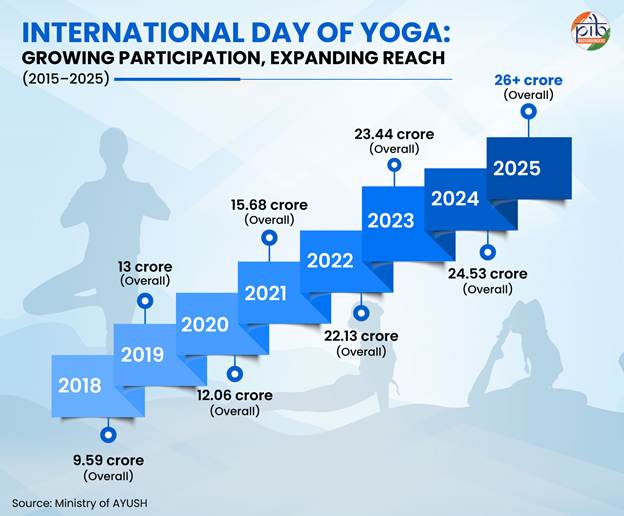
Over 11 editions, IDY has grown from a global observance into a people-led movement for preventive healthcare, healthier living and inner balance. Today, it is observed in more than190 countries.
International Day of Yoga 2026: What Is Happening This Year.
The 12th edition of the International Day of Yoga is being observed on 21stJune 2026, with Kolkata hosting the main national celebration. This year's theme, 'Yoga for Healthy Ageing' (स्वस्थ आयु के लिए योग), reflects a growing global emphasis on healthy and active living across the lifespan. As populations age and non-communicable diseases and lifestyle-related health concerns rise globally, the emphasis is shifting from simply adding years to life to enhancing health span, quality of life and overall well-being.
Building the Foundations of Healthy Ageing Through Yoga.