India is nearing completion of its first bullet train corridor - the Mumbai-Ahmedabad High Speed Rail (MAHSR). In doing so, it is shaping the future of high-speed rail in India. These trains have a design speed of upto 350 km per hour - much faster than the Vande Bharat trains that have a design speed of 180 km/hour.
Based on the MAHSR project, a standardised template is being developed for upcoming bullet train corridors across the country. The approach aims to implement proven engineering designs, construction methods, and operational practices. It will improve efficiency and accelerate project execution. The MAHSR project is thus laying the foundation for a transformation.
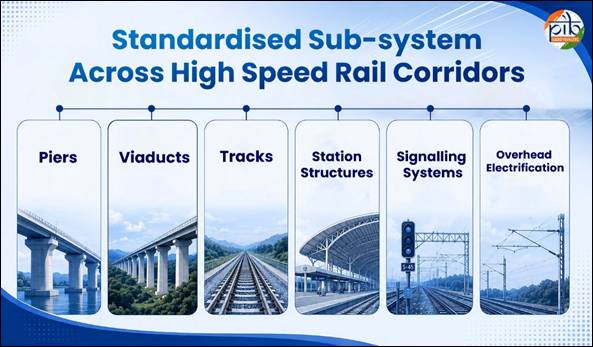
Unified designs, components, and maintenance procedures will simplify spare-part management, training, and procurement across the network. Future high-speed rail corridors will follow a replicable construction philosophy. Foundations will be designed according to the exact soil characteristics of the spot. The remaining subsystems will follow common engineering standards. These include piers, viaducts, tracks, station structures, overhead electrification, and signalling systems. This approach will support faster construction across future corridors. It will improve quality and reduce costs across future high-speed rail corridors.
Under the Make in India and Aatmanirbhar Bharat initiatives, Indian Railways is promoting indigenous high-speed rail manufacturing. This aims to reduce dependence on imported systems and components. Integral Coach Factory (ICF), in collaboration with Bharat Earth Movers Limited (BEML), is designing and manufacturing indigenous 280 kmph high-speed train sets. The tooling, testing and production ecosystem for future high-speed rail projects is also being developed in the country. Indian companies are increasingly manufacturing specialised components, construction equipment and slab-track systems required for high-speed rail. Aditya, a newly inaugurated specialised complex in Bengaluru, is designed for the development of B-28 coaches. Research by IITs, specialised training and the adoption of Japanese engineering practices are strengthening India's high-speed rail capabilities. This is.
The Mumbai-Ahmedabad High-Speed Rail (MAHSR) corridor marks India's entry into the era of high-speed rail. As the country's first dedicated bullet train corridor, it introduces advanced technologies and world-class safety standards.
The corridor will connect Mumbai and Ahmedabad in about 1 hour 58 minutes.
It covers a total length of approximately 508 kilometres.
The corridor has a design speed of 350 kmph and an operational speed of 320 kmph. It is supported by advanced rolling stock, signalling, and train control systems.
The MAHSR Project is being developed using Japanese Shinkansen technology and operational practices. The corridor incorporates advanced systems for traction, electrification, track infrastructure, and operations. Key technical components include.
More than 20,000 OHE masts are planned across the corridor. The 2×25 kV overhead traction system is based on Shinkansen-style OHE cantilever designs.
Traction and Power Supply: The project comprises 12 traction substations, 2 depot traction substations, and 16 distribution substations.
Track System: J-Slab ballastless track technology is being introduced in India for the first time.
Track Construction Bases: Dedicated Track Construction Bases are being developed. These are for the storage and handling of rails, track slabs, machinery, and other equipment.
Rolling Stock Depots: Three depots are being constructed at Sabarmati and Surat in Gujarat, and at Thane in Maharashtra.