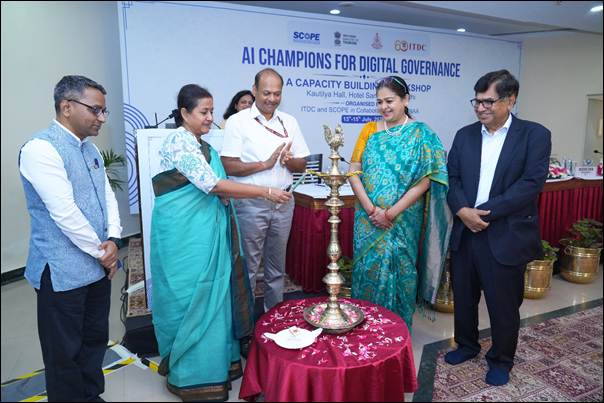
A three-day AI Digital Governance Champions summit opened in New Delhi with a clear institutional message: artificial intelligence is now part of the public-sector management agenda, not just a technology department subject.
The summit is being conducted by India Tourism Development Corporation in collaboration with SCOPE and the Lal Bahadur Shastri National Academy of Administration. The official release said it is designed to build practical AI capability among senior leadership and operations teams.
Institutional readiness
The timing is important because AI systems are already entering grievance handling, public communication, data classification, tourism services, procurement support and internal workflow. Institutions that do not understand the technology may either avoid useful tools or adopt them without safeguards.
The release linked the summit with the India AI Mission. Participants and speakers included Capacity Building Commission chair S. Radha Chauhan, Tourism and Culture Secretary Vivek Agarwal, LBSNAA joint director Ganesh Shankar Mishra, SCOPE director general Atul Sobti and ITDC managing director Mugdha Sinha.
Training senior officials is not a cosmetic step. AI choices affect procurement, privacy, cyber security, bias, service quality and public accountability. A poorly designed chatbot or document classifier can create real administrative harm if citizens are misdirected or records are misread.
Public-sector standard
The strongest version of such training should teach officials how to define use cases, test outputs, protect sensitive data, read audit logs and know when a human decision is required. It should also make clear that AI cannot replace statutory responsibility.
The summit will be worth tracking if it leads to repeatable standards across public-sector organisations rather than one-time orientation. India's governance systems need officers who can use AI with caution, speed and accountability at the same time.
Public-sector adoption also requires clarity on vendors. Agencies should know what data leaves their systems, where models are hosted, how outputs are logged and whether a tool can be independently audited before it is used for citizen-facing services.
A practical training programme should therefore include procurement officers, legal teams and operations staff along with senior leaders. AI governance is not only about vision; it is about everyday decisions on forms, records, data retention and grievance escalation.
Source: release dated 13 July 2026, Release ID 2284296.