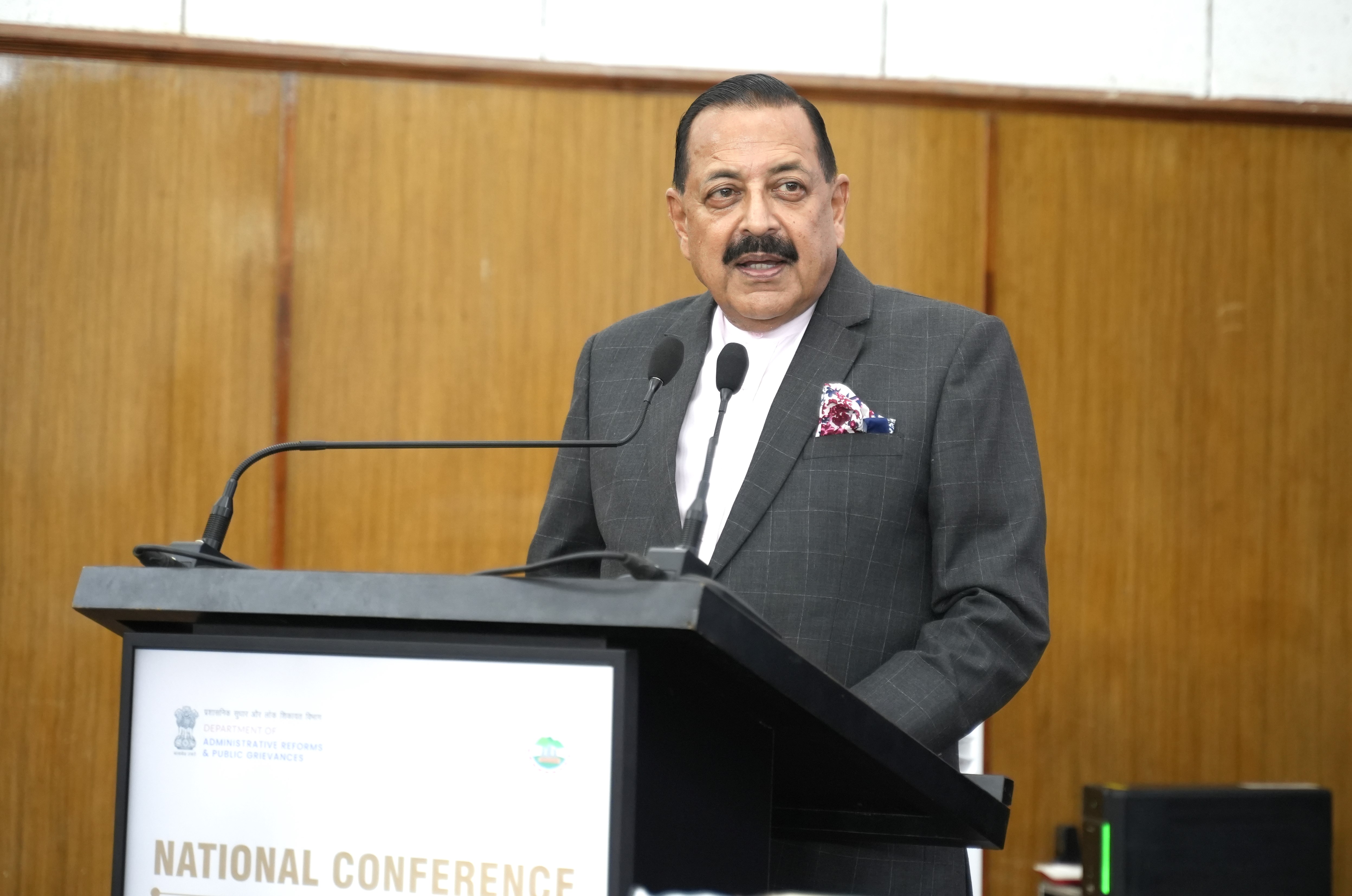
Union Minister Dr Jitendra Singh used a national governance conference in Shillong to place artificial intelligence inside the next phase of administrative reform, saying the coming challenge is to make digital government more responsive, secure and citizen-facing.
The official release said the two-day conference focused on next-generation administrative and e-governance reforms. Its themes included AI, cyber security, digital public infrastructure, citizen service platforms and the Viksit Bharat 2047 framework.
Administrative angle
The minister linked the reform agenda with changes already made in the grievance and compliance systems. He said complaints handled through CPGRAMS have risen from about two lakh in 2014 to about 25 lakh now, making speed, classification and tracking important for public trust.
The release also referred to an AI-supported multilingual chatbot for grievance redressal. That is a useful direction if the system helps citizens file complaints clearly, understand status updates and reach the right department, but it will still need human review for complex or sensitive cases.
Dr Singh also said nearly 2,000 obsolete rules and compliances have been removed. Since 2021, special campaigns have generated more than Rs 4,000 crore from disposal and scrap, while freeing nearly 700 lakh square feet of office space, according to the release.
Governance stakes
The policy question is whether AI will be treated as a display tool or as part of a disciplined administrative system. Public agencies need reliable datasets, audit trails, privacy safeguards, cyber resilience and officers trained enough to know when automated outputs are wrong.
The Shillong conference is important because it places AI reform in the everyday machinery of government rather than only in start-up or technology language. The best test will be whether grievance handling, file movement and citizen services become faster without weakening accountability.
A federal reform agenda also depends on state capacity. Many citizen services are delivered by state departments, municipalities and field offices, so the next phase will need training, procurement rules and interoperable systems outside New Delhi.
The strongest use cases are likely to be narrow and verifiable: sorting complaints, translating citizen requests, tracking service timelines, detecting file delays and helping officers compare rules. The risk rises when AI tools are allowed to make decisions without review.
Source: release dated 13 July 2026, Release ID 2284257.