Launched in 2016 and funded by the Embassy of Switzerland to India and Bhutan, the Capacity Building Project on Low Carbon and Climate Resilient City Development in India (CapaCITIES) programme has driven low-carbon, climate-resilient urban development. By directly strengthening local capabilities, the programme has supported India's 2070 net-zero emissions objective by aligning local action with national missions and state-level goals.
The initiative was implemented through a collaborative partnership involving ICLEI South Asia, South Pole and econcept, with the National Institute of Urban Affairs as the knowledge partner.Cities of Coimbatore, Thiruchirappalli Tirunelveli in Tamil Nadu, Ahmedabad, Rajkot, Vadodara, Udaipur and Siliguri and the state governments of Gujarat, Tamil Nadu received support from this project.
The convening gathered senior government officials, mayors, commissioners and engineers from 30+ cities, representatives from 6 state governments, high-level representatives from financial institutions, and technical experts to review a decade of building local climate capabilities and chart the future of urban sustainability.
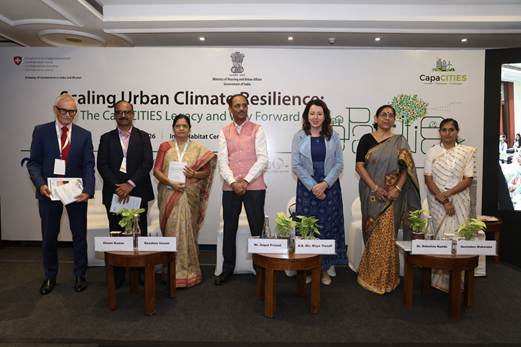
The inaugural session was attended by Mr Gopal Prasad, Economic Adviser, Ministry of Housing and Urban Affairs, Government of India, H.E. Ms Maya Tissafi, Ambassador, Embassy of Switzerland to India and Bhutan, Ms Geetaben Makwana, Mayor, Vadodara Municipal Corporation, Ms Daxaben Vasani, Deputy Mayor, Rajkot Municipal Corporation, Dr Debolina Kundu, Director, National Institute of Urban Affairs, and Mr Emani Kumar, Deputy Secretary General, ICLEI and Executive Director, ICLEI South Asia. The session focused on the scaling up and institutionalisation of locally led climate action in urban India.
Speakers at the inaugural session emphasised that India's urban climate transition must move beyond policy intent to institutional implementation. They underscored the need to embed climate action within urban planning systems, strengthen local capacities, scale successful city-led models, and deepen partnerships to accelerate climate-resilient urban development.
Stressing the importance of institutionalising climate action in city governance, Gopal Prasad, Economic Adviser, Ministry of Housing and Urban Affairs, Government of India, said, "Integrating climate action with urban planning is important, but the real challenge is demonstrating how it can actually be done. The model developed through this programme can be emulated across India and scaled up in the next phase.The dedicated climate cells need to be established within urban local bodies so that cities can integrate climate considerations into their planning processes and build the institutional capacity needed for effective implementation.".
Highlighting the decade-long India-Switzerland partnership behind the initiative, H.E. Ms Maya Tissafi, Ambassador, Embassy of Switzerland to India and Bhutan, said, "When Switzerland decided to support the CapaCITIES programme, the mission was clear: strengthen institutions, build local capacities, and aid city governments to integrate climate considerations into the way they plan and budget for their cities. Today we are celebrating 10 years of trust, partnership and shared learnings between India and Switzerland.".
Dr Debolina Kundu, Director, National Institute of Urban Affairs, said the programme had demonstrated that climate action could generate multiple developmental co-benefits while creating replicable models for cities across the country. She added, "Under CapaCITIES, projects have provided multifold impacts like livelihood generation, community awareness, women empowerment & ecosystem restoration, besides emissions reduction. The cities that have built impact under the CapaCITIES programme can act as lighthouses for other cities in India. Continued cross-pollination of ideas across India's local urban landscape will be imperative as we move towards Viksit Bharat.".
Calling the event the beginning of the programme's next phase, Emani Kumar, Deputy Secretary General, ICLEI and Executive Director, ICLEI South Asia, said, "ICLEI South Asia, through projects like CapaCITIES, is fully committed to Prime Minister Narendra Modi's Panchamrit goals, ensuring our work is deeply embedded in national missions like Mission LiFE, the SmartCitiesMission, AMRUT and readiness for the recent Urban Challenge Fund. Today's event is a step forward, marking the beginning of a new chapter in India's onward journey towards climate-resilient, future-ready cities.".
The technical sessions that followed elaborated on mainstreaming climate considerations into urban planning, scaling successful local demonstrations through programmes like CITIIS 2.0 and TNCRUDP, and mobilizing capital through innovative financing to modernize sustainable infrastructure. Participating state and municipal officials also shared their experiences with developing and implementing projects and their on-ground impacts.
The event also saw the launch of three CapaCITIES Knowledge Products-the Net-Zero Climate Resilient Cities Methodology Toolkit, Energy Transition for Urban Local Bodies (ULBs) in India: A Practitioner's Guidebook, and Facilitating the Transition of Cities in India Along a Low-Carbon Pathway: Enabling the Flow of Finance, a white paper. In addition, a Video Training Series on Preparation and Implementation of Net-Zero Climate Resilient City Action Plans was launched, which is now available on the National Urban Learning Platform. Developed as practical resources, these publications aim to help cities across India scale up low-carbon, climate-resilient development. Participants also visited an exhibition showcasing the programme's decade-long impact through stories from cities, practitioners, and local communities.
The event also highlighted the systemic changes and scalable urban solutions achieved by the programme over the past decade.
Net-Zero Planning: Pioneered Net-Zero Climate Resilient City Action Plans (CRCAPs) across eight cities in four states: Ahmedabad, Rajkot, Vadodara, Coimbatore, Tiruchirappalli, Tirunelveli, Siliguri, and Udaipur.
Institutional Governance: Established permanent Net-Zero and Climate Action Cells in six project cities to enable long-term implementation, monitoring, and climate budgeting.