Under AMRUT 2.0, cities across the country are advancing rainwater harvesting, groundwater recharge and sustainable water management to strengthen water security and climate resilience. The campaign has witnessed active participation from 27 States and Union Territories around 900 Urban Local Bodies (ULBs).
MoHUA in convergence with MoJS, under Jal Shakti Abhiyan-Jan Bhagidari (JSJB) 2.0, 1,99,278 recharge structures have been taken up by 79 Municipal Corporations, while 73,036 recharge structures are being implemented across 738 Urban Local Bodies, significantly contributing to groundwater recharge and water conservation efforts in urban areas.
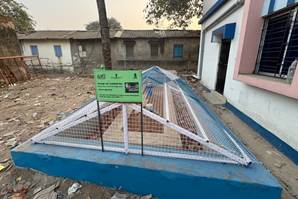
Further strengthening these efforts, the Shallow Aquifer Management (SAM) Programme is being implemented under AMRUT 2.0 to enhance groundwater recharge through scientific aquifer mapping and targeted interventions. The programme is delivering significant & tangible results across cities. In Burdwan (West Bengal) and Vizianagaram (Andhra Pradesh), recharge pits integrated with injection borewells are channelizing rainwater into deeper aquifers. In Itanagar (Arunachal Pradesh), rooftop rainwater harvesting systems with storage facilities are supporting both water conservation and groundwater replenishment. Meanwhile, Korba (Chhattisgarh) and Warangal (Telangana) have operationalized recharge structures ahead of the monsoon, ensuring that seasonal rainfall is effectively captured and utilized for aquifer replenishment.
Recharge pits with injection bore wells construted in Burdwan, West Bengal and Vizingarim, Andhra Pradesh.
Recharge structures under construction before monsoon in Korba, Chhattisgarh and Warangal, Telanga.
Recharge pit with storage tank facility for rooftop rainwater harvesting in Itanagar.
Under the Water Body Rejuvenation (WBR) component of AMRUT 2.0, nearly 1.21 lakh acres is being rejuvenated to improve water storage, enhance groundwater recharge and strengthen urban flood resilience. These interventions include desilting, inlet and outlet improvements, shoreline protection, landscaping and biodiversity enhancement.
Complementing these efforts, parks and green space projects spanning over 18,00 acres are being developed across urban India. These projects are enhancing environmental sustainability, supporting groundwater recharge, mitigating urban heat stress and improving the quality of life for citizens through the creation of accessible and vibrant public spaces.
Through these initiatives, MoHUA is contributing to the vision of "Catch the Rain - Where it Falls, when it Falls".
"Every drop saved today is an investment in the water security of future generations.".