Over the last twelve years, India's space programme has emerged as a symbol of national confidence, technological self-reliance, and global ambition. What began as a scientific endeavour has evolved into a strategic national asset that supports development, strengthens security, drives innovation, and enhances India's standing in the world. This journey reflects the spirit of 12 Years of Vishwas Ke, Nirman Ke and Jan Kalyan Ke-building trust through achievement, creating new opportunities through innovation, and delivering benefits that reach every citizen.
Three defining pillars have shaped this transformation. Firstly, India's Space Capability has extended the nation's reach beyond Earth through landmark missions, advanced launch systems, and indigenous technologies. Additionally, building National Capacity has leveraged space-based applications to strengthen governance, connectivity, disaster management, agriculture, healthcare, education, and economic growth. Moreover, the global.
These achievements tell the journey of a nation that is not only reaching new frontiers in space but also harnessing space technology to empower its people, strengthen its institutions, and elevate India's standing in the global arena. It is a journey guided by national purpose, and focused on improving lives.
Over the past decade, India has steadily expanded the scope of its space programme. It began with a focus on space exploration, which has now evolved into a broader effort to advance scientific research, develop cutting-edge technologies, and strengthen national capabilities. Today, India is pursuing ambitious goals across deep-space exploration, space science, human spaceflight, and orbital infrastructure. These achievements reflect growing confidence, technological maturity, and a long-term vision for India's role in the global space ecosystem.
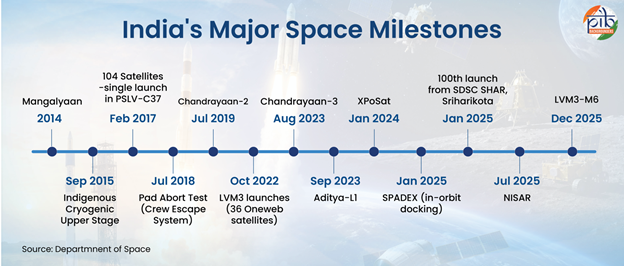
India's lunar journey reflects a sustained commitment to scientific discovery and technological advancement. The foundation was laid with Chandrayaan-1 in 2008, India's first mission to the Moon. The mission transformed global understanding of lunar resources by discovering evidence of water molecules and hydroxyl on the Moon's surface. Its Moon Impact Probe also provided valuable insights into the lunar exosphere. Further, Chandrayaan-2, launched in 2019, strengthened India's lunar programme. Operating from an altitude of 100 kilometres, it provided some of the highest-resolution images of the lunar surface and captured details as fine as 30 centimetres. Chandrayaan-1and Chandrayaan-2 established India as a serious contributor to global lunar science and laid the groundwork for future exploration.
That foundation further culminated in a historic achievement on 23 August 2023. Chandrayaan-3 made India the first country to achieve a soft landing near the Moon's south pole and the fourth nation after the United States, Russia, and China to successfully soft-land on the lunar surface. The Vikram lander touched down at 69.3° South latitude, a region never previously reached by any spacecraft. Scientific instruments conducted in-situ studies and confirmed the presence of Sulphur through direct elemental analysis. India's lunar ambitions continue to grow. Chandrayaan-4, planned for 2027, aims to land on the Moon, collect samples, and return them to Earth. The Chandrayaan-5/LUPEX (LUnar Polar EXploration) mission, will explore water and other volatile materials in permanently shadowed regions near the lunar south pole, taking India deeper into the next era of lunar exploration.
The Mars Orbiter Mission, popularly known as Mangalyaan, marked India's entry into interplanetary exploration. On 24 September 2014, the spacecraft successfully entered Martian orbit, making India the first country to reach Mars on its maiden attempt. With this achievement, ISRO became only the fourth space agency in the world to place a spacecraft in orbit around Mars after United States' NASA, Russia's Roscosmos, and the European Space Agency (ESA). Originally designed for a six-month mission, Mangalyaan remained operational for more than eight years, far exceeding expectations. The mission generated valuable scientific data on Mars' atmosphere, exosphere, surface features, and interactions with solar winds. Beyond its scientific contributions, Mangalyaan demonstrated India's ability to execute complex deep-space missions with remarkable efficiency and established the country as a.
India expanded its space ambitions beyond planetary exploration with Aditya-L1, the country's first dedicated solar mission. Launched in 2023, the spacecraft was successfully placed in a halo orbit around the Sun-Earth L1 Lagrange Point, nearly 1.5 million kilometres from Earth. This unique position enables uninterrupted observation of the Sun and its dynamic activity. The mission studies the solar corona, solar winds, and space weather phenomena that influence Earth's environment and technological systems. Aditya-L1 has also been opened to the national scientific community as a proposal-driven observatory. Scientific data are regularly released in the public domain, strengthening global solar research. More than 27 TB of solar observation data have already been disseminated, making the mission an important contributor to international scientific knowledge.
Space Astronomy and Space Docking: Expanding Frontiers of Capability.
India has strengthened its position in advanced space science through astronomy and in-orbit technology demonstrations. AstroSat, India's first multi-wavelength space observatory, completed a decade in orbit in September 2025 and has contributed several important scientific discoveries. XPoSat, launched on 1 January 2024, further expanded India's capabilities in X-ray astronomy. Both missions continue to operate as proposal-driven observatories serving researchers worldwide.
Venus Orbiter Mission: Exploring Earth's Sister Planet.
Building on its achievements at the Moon and Mars, India is preparing its first mission to Venus. The Venus Orbiter Mission, approved by the Government of India, is targeted for launch in March 2028. The mission will study Venus' geology, surface composition, atmosphere, ionosphere, and resurfacing processes. Scientists will also examine how solar activity influences the planet's atmospheric and near-space environment. The mission represents a significant technological leap for India's space programme. It will attempt advanced capabilities such as aerobraking and sophisticated thermal management systems to operate in Venus' extreme conditions. These technologies are being undertaken by ISRO for the first time and will further strengthen India's expertise in deep-space exploration and planetary science.
As part of preparations for Gaganyaan, India participated in the ISRO-NASA supported Axiom-4 mission to the International Space Station in 2025. Group Captain Shubhanshu Shukla travelled aboard the SpaceX Dragon spacecraft launched by Falcon 9 on 25 June 2025. During the mission, he conducted seven microgravity experiments developed by Indian research institutions. The studies examined muscle regeneration, algal growth, crop viability, microbial survivability, cognitive performance, and cyanobacterial behaviour in space. The mission concluded successfully on 15 July 2025 with safe undocking, re-entry, and splashdown. Beyond its scientific outcomes, Axiom-4 provided India with valuable operational experience in astronaut training, human spaceflight procedures, microgravity research, and international collaboration, strengthening the country's readiness for future crewed missions.
Bharatiya Antariksh Station (BAS) is India's planned space station and a key pillar of Space Vision 2047. BAS will be a five-module space station in Low Earth Orbit, designed to support long-duration human space missions and advanced scientific research in microgravity. In September 2024, the Union Cabinet approved the development and launch of the first module, BAS-01, by 2028 as part of the expanded Gaganyaan programme. The station will enable research in life sciences, medicine, and emerging technologies while supporting future human exploration missions beyond Earth orbit.